

Tuesday, March 8, 2011


Saturday, July 10, 2010
Linux Doesn't Cost Anything - But Maybe It Should
Discussions, theses, theories and memes abound around Linux's inability to gain traction in the desktop marketplace. Some think the Linux Desktop is too hard to learn (it's not). Others say Linux Desktop is deficient (it's not). Linux elite (or 1337) say Linux wasn't really meant for the general users anyway (not true). Microsoft says Linux in general is evil (see the Halloween Memo) (oh, and by the way, it's not).

Why, you wonder, when all along we've sung the FOSS praises of GNU/Linux (hereafter referred to as the more simple "Linux," with all deference to Stallman) and that Linux is free? What could be better than free? If Linux Desktop is free and can't gain more marketshare (estimates range somewhere around 1 percent Linux Desktop market penetration) then one or a combination of the above reasons must be why Linux fails. If Linux passes all points in the opening paragraph, what gives?
Users of Linux Server barely blink that Linux is free -- they're much more interested that Linux is excellent. Their measuring stick is based on deep technological understanding, and hence they do not need to look to alternate valuations. And in the server market, Linux thrives in spite of being free.
Then how?
I wish I knew, but I'm in the opinion business. I do think Linux Desktop gains main street cred when someone finds a way to cut, polish and mount a Linux Desktop diamond in the rough. Polished, packaged and priced like a real product, Linux Desktop offers attractive marketing opportunities. Linux Desktop is ready for prime time. Linux Desktop needs to look, feel, smell and cost like prime time. We're more likely to proudly show off our shiny new desktop we bought. And that is how we create a Linux Desktop buzz.
Linux Desktop buzz is what's been missing. Really. And the company that finds a way to create the buzz puts Linux a chip shot away from real market share. Linux Desktop -- it's going to cost you. And it should.

Why, you wonder, when all along we've sung the FOSS praises of GNU/Linux (hereafter referred to as the more simple "Linux," with all deference to Stallman) and that Linux is free? What could be better than free? If Linux Desktop is free and can't gain more marketshare (estimates range somewhere around 1 percent Linux Desktop market penetration) then one or a combination of the above reasons must be why Linux fails. If Linux passes all points in the opening paragraph, what gives?
But Is Linux Really Good Enough?
Let's revisit the opening common claims to Linux's failings:- Linux is too hard to learn: Fail. Linux, especially Linux Desktop, couldn't be easier to learn. In the last 10 years Linux usability work has exploded with ideas and implementations. A Linux Desktop may be different (think Ubuntu vs. RedHat, Gnome vs. KDE), but it's only different. I've never had to abandon teaching someone how to use a Linux Desktop.
- Linux is deficient: Nope. Not even close. As an anecdotal example, I recently connected an old XP laptop to my 1920x1200 monitor to make work on that computer easier. Alas, the video drivers available could not drive the resolution on my monitor -- even after downloading and installing updates for XP and the vendor drivers. However, the Linux side of that dual-boot laptop happily fired up and handled the screen resolution perfectly. This is one example of many times I've seen Linux rise to a technical challenge while Windows failed. This point begs more discussion. In future articles I promise to drill more deeply into this topic. For now, I submit that in my (more than anecdotal) opinion, Linux Desktop is far from deficient.
- Linux wasn't meant for the general user: Uh-uh! Geek elites are confusing technical obfuscation of what is possible to do (Unix command line, etc.) with what is transparently easy to do today on any Linux Desktop (browse and manage files, surf the Internet, write and manage documents, handle e-mail, etc.). Linux can be as difficult as you want it to be to learn, but for general desktop use and day-to-day tasks, Linux Desktop couldn't be more appropriate for general use.
Why Don't Linux Servers Suffer Same Fate?
The users of Linux Server technology are extremely technical, and with good reason. They support technology on which businesses run.Users of Linux Server barely blink that Linux is free -- they're much more interested that Linux is excellent. Their measuring stick is based on deep technological understanding, and hence they do not need to look to alternate valuations. And in the server market, Linux thrives in spite of being free.
But Linux Has to Be Free!
Yes, Linux is Open Source and Linux is free. But there are myriad ways to combine the free Linux with added value. Water is free too (kind of), and you don't find people hesitate to pay a buck-fifty for 12 ounces of it because it's in a pretty plastic bottle! There are ways.Then how?
I wish I knew, but I'm in the opinion business. I do think Linux Desktop gains main street cred when someone finds a way to cut, polish and mount a Linux Desktop diamond in the rough. Polished, packaged and priced like a real product, Linux Desktop offers attractive marketing opportunities. Linux Desktop is ready for prime time. Linux Desktop needs to look, feel, smell and cost like prime time. We're more likely to proudly show off our shiny new desktop we bought. And that is how we create a Linux Desktop buzz.
Linux Desktop buzz is what's been missing. Really. And the company that finds a way to create the buzz puts Linux a chip shot away from real market share. Linux Desktop -- it's going to cost you. And it should.
Tuesday, July 6, 2010
Dell's 'Love Letter' to Linux: Now You See It, Now You Don't?
Dell gave Ubuntu Linux a wet, sloppy kiss on its Web site recently, asserting that the distro is just plain safer than Microsoft Windows. It was item No. 6 on Dell's list of things people should know about Ubuntu, and Linux lovers were pleasantly surprised by the candor. Within days, though, the mention of Windows had been removed. "To be honest, I'm surprised that Dell had that up as long as they did,".

"Hoorah!" one might say. "At long last!"
Dell's uplifting words of endearment caused considerable joy and jubilation among Linux aficionados far and wide, including The VAR Guy, Network World and the rowdy crowd over at Digg, among many others.
Too bad it didn't last.
The new wording: "Ubuntu is secure," item No. 6 now reads. "According to industry reports, Ubuntu is unaffected by the vast majority of viruses and spyware."
Foul!
Bloggers everywhere could be heard expressing sentiments to that effect when the news broke, and Linux Girl was no exception.
To be honest, I'm surprised that Dell had that up as long as they did."It's not that Microsoft would take objection to their saying nice things about Linux -- Dell is still saying nice things about Linux, after all -- it's that they were undermining the promotion of a competing product that they also sell." The original wording, in fact, "was an extraordinarily bad idea from a business perspective, and somebody at Dell dropped the copy-editing ball by allowing it to be posted,".
Ubuntu may be safer, "but you have to have a CS degree to run it," he explained. "If I lock a Windows box in concrete and bury it, the box will be pretty safe too, but not very usable."
"As long as Dell isn't saying something like, 'Windows is more secure than Linux' or 'Linux is not secure,' and as long as they're actually providing models they certify for Ubuntu, I'll definitely check dell.com/ubuntu before purchasing a computer,"
Even more to the point: "It's safe and secure. Over 95 percent of viruses, spyware and other types of malware are designed and targeted to attack Microsoft Windows," the video asserts. "So, by definition, if you're not running Microsoft Windows and if you're running Linux, you just don't have to worry about malware and viruses and spyware."

Well, it's been an emotional rollercoaster ride here in the Linux blogosphere in recent days, thanks to Dell's proclamation -- and then apparent retraction -- of its love for Linux.
"Ubuntu is safer than Microsoft (Nasdaq: MSFT) Windows" read item No. 6 on Dell's "Top 10 list of things you should know about Ubuntu" as recently the middle of this month. "The vast majority of viruses and spyware written by hackers are not designed to target and attack Linux," it added."Hoorah!" one might say. "At long last!"
Dell's uplifting words of endearment caused considerable joy and jubilation among Linux aficionados far and wide, including The VAR Guy, Network World and the rowdy crowd over at Digg, among many others.
Too bad it didn't last.
'Ubuntu Is Secure'
Sometime between the June 16 and 21, apparently, Dell thought better of its little public display of affection and carefully reworded that particular item.The new wording: "Ubuntu is secure," item No. 6 now reads. "According to industry reports, Ubuntu is unaffected by the vast majority of viruses and spyware."
Foul!
Bloggers everywhere could be heard expressing sentiments to that effect when the news broke, and Linux Girl was no exception.
To be honest, I'm surprised that Dell had that up as long as they did."It's not that Microsoft would take objection to their saying nice things about Linux -- Dell is still saying nice things about Linux, after all -- it's that they were undermining the promotion of a competing product that they also sell." The original wording, in fact, "was an extraordinarily bad idea from a business perspective, and somebody at Dell dropped the copy-editing ball by allowing it to be posted,".
Ubuntu may be safer, "but you have to have a CS degree to run it," he explained. "If I lock a Windows box in concrete and bury it, the box will be pretty safe too, but not very usable."
"As long as Dell isn't saying something like, 'Windows is more secure than Linux' or 'Linux is not secure,' and as long as they're actually providing models they certify for Ubuntu, I'll definitely check dell.com/ubuntu before purchasing a computer,"
Even more to the point: "It's safe and secure. Over 95 percent of viruses, spyware and other types of malware are designed and targeted to attack Microsoft Windows," the video asserts. "So, by definition, if you're not running Microsoft Windows and if you're running Linux, you just don't have to worry about malware and viruses and spyware."
The Disruptive Technology Myth
"Disruptive" technologies do not destroy industries -- they may, however, create new ones. Whether we like it or not, we are in a constant state of flux. The technology industry, just like any industry, is incredibly dynamic and changing -- and with change, comes opportunity.
PC World's Dan Tynan gets it. He called out "The 10 Most Disruptive Technology Combinations". ... There needs to be a "two-part punch" to really disrupt the status quo. Industries evolve based on new technology, but the real test is how companies use the technology to change their delivery model and sales structure.Currently, Web service providers such as Amazon , Google and even Force.com claim that the Software as a Service (SaaS) cloud offerings will change the way the entire world operates -- and, in so doing, will destroy existing technology businesses.
That simply is not true. In fact, Amazon likely buys more computers and storage systems than any other company in the world.
These powerhouse Web service providers are not changing the game; they are simply buying things in bulk and reselling them virtually. What Amazon, Google and Force.com are doing well is creating a new delivery model and a new sales structure so that customers build additional applications on top of their technology foundation until they are at the core of the business itself.
Let us explore the top three myths surrounding the "disruptor du jour": the SaaS cloud.
Myth: The SaaS cloud is disruptive.
Everywhere you look, the SaaS cloud is being pegged as a "disruptive" technology. Many think that if a solution is "in" the cloud -- whether it is customer relationship management software or a service that ensures any file you send to internal/external business partners gets where it needs to be -- it is automatically disruptive.
Providing something virtually is NOT disruptive; cloud computing is not the disruptor. The real disruptor is how you use it, why you use it and where you use it.
Myth: Throw it into the cloud, and it will be a success.
You can toss it up, but there is no guarantee anyone will be there to catch it. Any technology can be put "into" the cloud, but few will be successful. To have a successful SaaS/cloud offering, the underlying technology must be:
- 1.) Proven
- 2.) Secure
- 3.) Scalable
Myth: The cloud will ruin the technology industry.
The industry "experts" beating this drum are dead wrong. Virtual offerings will not destroy any industry. While cloud-based offerings will continue to make innovators rethink their delivery models, the need for enterprise software/hardware will not go away -- at least, not any time in the foreseeable future.
Computers, hardware, storage, routers, racks and networks -- they are all still here, and they are more critical to businesses of all sizes than ever. They are simply being used in different ways and for different reasons -- and one might argue, much more efficiently.
The technology industry is fluid, and the innovative leaders across all sectors will use the SaaS cloud to make their technology offering more accessible, grow their bottom line, and build on their success. It opens a new door for technology providers to offer enterprises the tools that they need and pay only for what they use -- eliminating previous infrastructure and cost barriers.
While not every technology is made for the cloud, there is significant opportunity to use the cloud to your advantage, whether you are a technology provider or a technology consumer. So, before you bury your head in the sand, think about how you can embrace the cloud and make it work to your advantage.
Calibre-An Elegant E-Book Librarian
Regardless of your take on the iPad as a do-everything replacement device for laptops and netbooks, other e-book readers (EBRs) are gaining a substantial foothold. Devices such as the Kindle and the Nook provide access to volumes of literature and documents without having to lug a fully-functional computer around.

However, EBRs do not completely replace the need for notebooks and netbooks. Depending on your specific needs, both laptop/netbook-based EBR software and a stand-alone e-book device can be indispensable for portable access to work-related and recreational reading. A Linux app called "Calibre" bridges the gap between both reading devices.
Calibre is a free, cross-platform e-book library management application for Linux, OS X and Windows. This open source app goes far beyond letting you access your collection of e-books on a computer. In many ways, Calibre does for e-books what other Linux apps do for your digital picture libraries and music collections.
My first exposure to e-books other than those distributed in PDF format was a handy EBR app called "FBReader,", a free e-book reader that runs on Linux desktop and portable computers. It is a handy program for accessing the thousands of free titles of literature stored on the Internet. It works great as a basic EBR, but its functionality is limited to that narrow focus.
I discovered Calibre while searching for a program that converted e-book formats to the .fb2 code that the FBReader uses. Do not try out Calibre if you are looking for an app to break the Digital Rights Management (DRM) lock some publishers use to protect the purchase price of ebooks they sell. Calibre will not help you there.
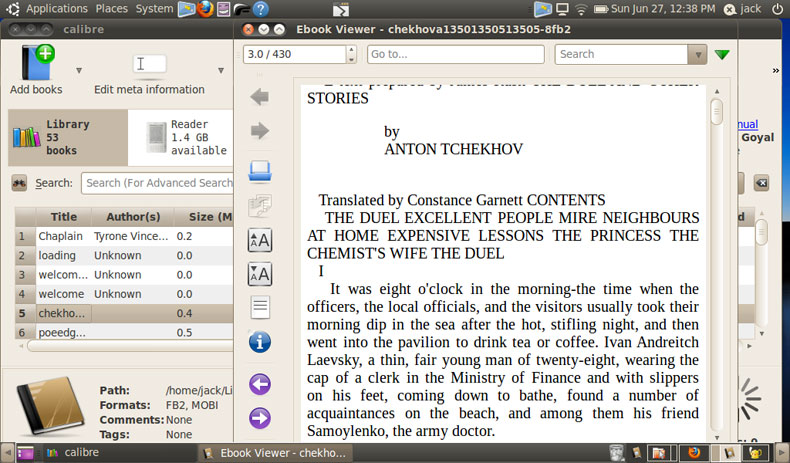
However, EBRs do not completely replace the need for notebooks and netbooks. Depending on your specific needs, both laptop/netbook-based EBR software and a stand-alone e-book device can be indispensable for portable access to work-related and recreational reading. A Linux app called "Calibre" bridges the gap between both reading devices.
Calibre is a free, cross-platform e-book library management application for Linux, OS X and Windows. This open source app goes far beyond letting you access your collection of e-books on a computer. In many ways, Calibre does for e-books what other Linux apps do for your digital picture libraries and music collections.
My first exposure to e-books other than those distributed in PDF format was a handy EBR app called "FBReader,", a free e-book reader that runs on Linux desktop and portable computers. It is a handy program for accessing the thousands of free titles of literature stored on the Internet. It works great as a basic EBR, but its functionality is limited to that narrow focus.
I discovered Calibre while searching for a program that converted e-book formats to the .fb2 code that the FBReader uses. Do not try out Calibre if you are looking for an app to break the Digital Rights Management (DRM) lock some publishers use to protect the purchase price of ebooks they sell. Calibre will not help you there.
Friday, July 2, 2010
New rules bring online piracy fight to US campuses
Starting this month, colleges and universities that don't do enough to combat the illegal swapping of "Avatar" or Lady Gaga over their computer networks put themselves at risk of losing federal funding.
A provision of the Higher Education Opportunity Act of 2008 is making schools a reluctant ally in the entertainment industry's campaign to stamp out unauthorized distribution of copyrighted music, movies and TV shows.
Colleges and universities must put in place plans "to effectively combat the unauthorized distribution of copyrighted material by users of the institution's network" without hampering legitimate educational and research use, according to regulations that went into effect Thursday.
That means goodbye to peer-to-peer file-sharing on a few campuses — with exceptions for gamers or open-source software junkies — gentle warnings on others and extensive education programs everywhere else.
Despite initial angst about invading students' privacy and doing the entertainment industry's dirty work, college and university officials are largely satisfied with regulations that call for steps many of them put in place years ago.
But whether the investment of time and money will make a dent in digital piracy is uncertain.
Among other things, schools must educate their campus communities on the issue and offer legal alternatives to downloading "to the extent practicable."
Colleges and universities that don't comply risk losing their eligibility for federal student aid.
Many colleges worried they would be asked to monitor or block content. But the provision says schools can get a great deal of flexibility, as long as they use at least one "technology-based deterrent."
Their options include taking steps to limit how much bandwidth can be consumed by peer-to-peer networking, monitoring traffic, using a commercial product to reduce or block illegal file sharing or "vigorously" responding to copyright infringement notices from copyright holders.
Few campuses have gone as far as Illinois State, which raised eyebrows by seeking and accepting entertainment industry money to underwrite a now-abandoned research project on digital piracy.
The university also blocked all peer-to-peer activity in residence halls and on wireless access points, said Mark Walbert, Illinois State's chief technology officer. Students who use the technology for legal means — like tapping open-source software Linux or downloading World of Warcraft game updates — can get exceptions.
For students seeking legal download options, the school developed BirdTrax, a Web page with links to the free movie and music streaming websites such as Hulu and Pandora.
In 2007, the University of Michigan took a different approach, launching a campus initiative called "BAYU," which stands for "Be Aware You're Uploading." At little cost, the school developed a software program that automatically notifies users of university networks when they are uploading, or sharing files from their computer with users elsewhere.
File-hosting services such as RapidShare store infringing content on distant servers, meaning uploaders' identities are difficult to track. Websites that share links to those files are searchable through Google.
"It's a much more complicated battle than it was five years ago because so many new modes of infringement are emerging
A provision of the Higher Education Opportunity Act of 2008 is making schools a reluctant ally in the entertainment industry's campaign to stamp out unauthorized distribution of copyrighted music, movies and TV shows.
Colleges and universities must put in place plans "to effectively combat the unauthorized distribution of copyrighted material by users of the institution's network" without hampering legitimate educational and research use, according to regulations that went into effect Thursday.
That means goodbye to peer-to-peer file-sharing on a few campuses — with exceptions for gamers or open-source software junkies — gentle warnings on others and extensive education programs everywhere else.
Despite initial angst about invading students' privacy and doing the entertainment industry's dirty work, college and university officials are largely satisfied with regulations that call for steps many of them put in place years ago.
But whether the investment of time and money will make a dent in digital piracy is uncertain.
Among other things, schools must educate their campus communities on the issue and offer legal alternatives to downloading "to the extent practicable."
Colleges and universities that don't comply risk losing their eligibility for federal student aid.
Many colleges worried they would be asked to monitor or block content. But the provision says schools can get a great deal of flexibility, as long as they use at least one "technology-based deterrent."
Their options include taking steps to limit how much bandwidth can be consumed by peer-to-peer networking, monitoring traffic, using a commercial product to reduce or block illegal file sharing or "vigorously" responding to copyright infringement notices from copyright holders.
Few campuses have gone as far as Illinois State, which raised eyebrows by seeking and accepting entertainment industry money to underwrite a now-abandoned research project on digital piracy.
The university also blocked all peer-to-peer activity in residence halls and on wireless access points, said Mark Walbert, Illinois State's chief technology officer. Students who use the technology for legal means — like tapping open-source software Linux or downloading World of Warcraft game updates — can get exceptions.
For students seeking legal download options, the school developed BirdTrax, a Web page with links to the free movie and music streaming websites such as Hulu and Pandora.
In 2007, the University of Michigan took a different approach, launching a campus initiative called "BAYU," which stands for "Be Aware You're Uploading." At little cost, the school developed a software program that automatically notifies users of university networks when they are uploading, or sharing files from their computer with users elsewhere.
File-hosting services such as RapidShare store infringing content on distant servers, meaning uploaders' identities are difficult to track. Websites that share links to those files are searchable through Google.
"It's a much more complicated battle than it was five years ago because so many new modes of infringement are emerging
Thursday, July 1, 2010
From Me To Her
Here is my my first non-technical post
I don’t have to be your first kiss.
I kinda just want to be your last one.
Every now and then, three little words come out.
No, not I love you and no, not I hate you.
But, I miss you.
And for a second, I can’t stand myself.
Because I know you never thought about me.
As much as I still think about you.
i love how our personalities match
how we can talk for hours about anything and everything
how we can sit in silence comfortably
how we can be ourselves 100%
how we don't need to be together every second
but also love it when we get that chance
there's no attraction stronger than the invisible force
that pulls your lips to mine and neither of us can resist!
I love that you get cold when it's 43 degrees out.
I love that it takes you an hour and a half to order a sandwich.
I love that you get a little crinkle in your nose when you're looking at me like I'm nuts.
I love that after I spend day with you, I can still smell your perfume on my clothes.
And I love that you are the last person I want to talk to before I go to sleep at night.
And it's not because I'm lonely, and it's not because it's New Year's Eve. I came here tonight because when you realize you want to spend the rest of your life with somebody, you want the rest of your life to start as soon as possible.
You... complete me!
And the best one:
Look, I guarantee there'll be tough times. I guarantee that at some point, one or both of us is gonna want to get out of this thing. But I also guarantee that if I don't ask you to be mine, I'll regret it for the rest of my life, because I know, in my heart, you're the only one for me.

Hope you will like it.
I don’t have to be your first kiss.
I kinda just want to be your last one.
Every now and then, three little words come out.
No, not I love you and no, not I hate you.
But, I miss you.
And for a second, I can’t stand myself.
Because I know you never thought about me.
As much as I still think about you.
i love how our personalities match
how we can talk for hours about anything and everything
how we can sit in silence comfortably
how we can be ourselves 100%
how we don't need to be together every second
but also love it when we get that chance
there's no attraction stronger than the invisible force
that pulls your lips to mine and neither of us can resist!
I love that you get cold when it's 43 degrees out.
I love that it takes you an hour and a half to order a sandwich.
I love that you get a little crinkle in your nose when you're looking at me like I'm nuts.
I love that after I spend day with you, I can still smell your perfume on my clothes.
And I love that you are the last person I want to talk to before I go to sleep at night.
And it's not because I'm lonely, and it's not because it's New Year's Eve. I came here tonight because when you realize you want to spend the rest of your life with somebody, you want the rest of your life to start as soon as possible.
You... complete me!
And the best one:
Look, I guarantee there'll be tough times. I guarantee that at some point, one or both of us is gonna want to get out of this thing. But I also guarantee that if I don't ask you to be mine, I'll regret it for the rest of my life, because I know, in my heart, you're the only one for me.

Hope you will like it.
Sorry for going offline without prior information
First of all SORRY from my soul and heart to all the readers, who are reading this blog, for the inconvenience caused by me by remaining absent for such a long time, with giving any prior notice or any reason for this inconvenience.
I am SORRY.
But from now on, i will be regular from my side but i will not be that much frequent. i will not be able to post on daily basis, but on the contrary, i will be posting weekly.
Apart from technology related stuff, i have decided to put my life events and thoughts on the post.
Enjoy the posts.Thank You.
I am SORRY.
But from now on, i will be regular from my side but i will not be that much frequent. i will not be able to post on daily basis, but on the contrary, i will be posting weekly.
Apart from technology related stuff, i have decided to put my life events and thoughts on the post.
Enjoy the posts.Thank You.
Friday, April 2, 2010
How Long Will Rare Metals Last?
If you were wondering how long will global reserves of some important metals that are used in electronic devices last, here’s a clue.
Tantalum is a rare metal that is used in the manufacture of cell phones and camera lenses but you’ll be surprised to know that if every human on the planet were to consume this metal at the same rate an average US resident today, the metal supplies won’t last for more than 20 years.

Similarly, we won’t be left with any stock of Indium, another rare metal used in LCDs and touch-screen displays, after 4 years if the world consumes this metal at the same rate as US today.
This report, which roughly demonstrates how quickly time is running out for some rare and important metals, was original published in New Scientist in 2007.
Tantalum is a rare metal that is used in the manufacture of cell phones and camera lenses but you’ll be surprised to know that if every human on the planet were to consume this metal at the same rate an average US resident today, the metal supplies won’t last for more than 20 years.

Similarly, we won’t be left with any stock of Indium, another rare metal used in LCDs and touch-screen displays, after 4 years if the world consumes this metal at the same rate as US today.
This report, which roughly demonstrates how quickly time is running out for some rare and important metals, was original published in New Scientist in 2007.
What Percentage of Earth’s Water is Safe for Drinking

More than 75% of our planet is covered with water yet only 0.08% of that water is fit for human consumption.
YouTube goes ahead and cleans up its video page
Don’t be too surprised when you discover your favourite video repository has completely changed its look, removing the clutter and most of the red from its video pages. And no, this is not an April Fool’s Day gag.
YouTube is also being very helpful, giving you brief and detailed tours to choose from to aid you in getting to terms with the new interface, or in their words, the “new video page”, where a lot of clean naked boxes make up the page now, with serene white everywhere.

(1) Username , Subscribe button, and "More from User
YouTube is also being very helpful, giving you brief and detailed tours to choose from to aid you in getting to terms with the new interface, or in their words, the “new video page”, where a lot of clean naked boxes make up the page now, with serene white everywhere.

(1) Username , Subscribe button, and "More from User
(2) Video description (+ tags etc.)
(3) Ratings, Favorites / Playlists, and Share options
(4) Data and Statistics from Insight
(5) Video Response
(6) Video Comments
(7) Respond, rate, and flag comments
(8) Next in series / Up Next Queue
(9) Add to Queue (new version of Quicklist)
(10) Account options
Wednesday, March 31, 2010
Roccat Pyra Notebook Gaming Mouse

Roccat's latest rodent for notebook gamers
+ Good aesthetics, bundled software works well, easy to carry, good bundle, performs well in games
- No Teflon feet, cord is not braided, feels a little flimsy
God of War 3 (PS3)

Followed by a neat opening credits sequence that recounts the previous 2 games in a tapestry/painting style, the gameplay throws you literally right into where you left off at the end of God of War 2. It's almost like you've simply inserted your second disc and continuing the second game. It's a great transition.

Graphically the game is amazing. Movement and speed of the screen, actions, and characters are incredibly fluid and nice.

The controls are still smooth and easy to pick up on.

The action and fighting in this game is fantastic.Besides additional play throughs on the harder difficulties, there's also the Challenge Mode and the Combat Arena which you can only unlock by getting past all the challenges. You can also try enhanced play using various items you pick up throughout the game. However using the items during play disables your winning of trophies if you want to try for platinum.

This game delivers in every way. With how social videogaming has become with multiplayer, PSHome, co-op play, and other features, it's nice to get a game that simply delivers one of the best single-player story modes of all time.
Tuesday, March 30, 2010
Final Fantasy XIII reviewed
As this game is part of the Fabula Nova Crystalis series of games, the central theme revolves around the
uncontrollable and over-bearing power of ‘Crystals’ to influence life and politics. Final Fantasy XIII tells the story of two worlds — a land called the Pulse and a tiny planet called Cocoon that hovers over Pulse. The leaders of the two worlds have ensured that their people are extremely fearful and hateful of each other and the real story behind the struggle is revealed through the exploits of the a group of people from both worlds. One cannot help but notice the striking similarities between the game’s story and real-life events following the discovery of Black Gold that affects the world even today.
.jpg)
The game’s story will take you to a variety of different locations
.jpg) Best way to lay down massive damage is to first stagger the enemies with relentless offensive
Best way to lay down massive damage is to first stagger the enemies with relentless offensive
.jpg)
.jpg)
Snow here plays the role of a cocky hero who lives for flashy displays like this one
.jpg) Lighting with her guardian, the Eidolon Odin
Lighting with her guardian, the Eidolon Odin
.jpg) If you are looking for a game with a lot of game-play, Final Fantasy XIII is the deal of the season. Compared to the long hours, the game manages to keep things fresh right till the end and beyond.
If you are looking for a game with a lot of game-play, Final Fantasy XIII is the deal of the season. Compared to the long hours, the game manages to keep things fresh right till the end and beyond.
uncontrollable and over-bearing power of ‘Crystals’ to influence life and politics. Final Fantasy XIII tells the story of two worlds — a land called the Pulse and a tiny planet called Cocoon that hovers over Pulse. The leaders of the two worlds have ensured that their people are extremely fearful and hateful of each other and the real story behind the struggle is revealed through the exploits of the a group of people from both worlds. One cannot help but notice the striking similarities between the game’s story and real-life events following the discovery of Black Gold that affects the world even today.
.jpg)
The game’s story will take you to a variety of different locations
.jpg)
.jpg)
Yes, this one is as bad-ass as it looks
.jpg)
Snow here plays the role of a cocky hero who lives for flashy displays like this one
.jpg)
.jpg)
IPL 2010 :- FULL MATCH
Care to help Palm make a positive headline?

BTW, in looking at the current I think they are all pretty accurate, but have no idea how the BlackBerry Tour could have beaten the iPhone 3GS. The Tour doesn’t even have WiFi while the iPhone 3GS easily beats that device in terms of hardware and software, IMHO. Who do you think will be crowned Smartphone Champion? I have a feeling that my new T-Mobile HD2 has a good shot and am enjoying the new commercials I see for it on TV and the Internet.
Will there soon be an iPhone HD with 960x640 display and front facing camera?

Airtel Intros 50Mbps Broadband in India
India has been consistently lagging behind other countries when it comes to the availability of bandwidth and the overall Internet speed. While the situation is way better than what it use to be during our dial up days, even the best mainstream broadband connection averaged around 2 to 4Mbps in the country. This, at a time when countries like South Korea and Japan boast of average download speeds ranging from 60 to 100Mbps, told a sorry state of affairs.
However, in a change of some sorts of late we have been hearing of ultra high-speed broadband speeds in the country with increasing frequency of late. Back in 2009, Tata had announced its 100Mbps service in the country. It was followed by MTNL who launched a 20Mbps VDSL (Very High Bitrate DSL) service. Now, it's Airtel's turn to Launch its VDSL service in select regions of the country. Currently available only Delhi and Gurgaon, Airtel's new VDSL service boasts of speeds of up to 50Mbps!
 Airtel has informed that it would, in due course, bring the new service to the cities of Mumbai, Chennai and Bangalore.
As expected, services of this kind would never be light on the pocket. This 50Mbps Broadband plan comes at Rs. 8,999 per month rental with 200 GB free data transfer. It also offers you other added services like a Website Builder (Basic), Secure (Anti-Virus software) and even an On line Storage option. For games, there is a Games on Demand (GoD) service as well.
If you live in the NCR region, you might want to call up your nearest Airtel office ASAP!

However, in a change of some sorts of late we have been hearing of ultra high-speed broadband speeds in the country with increasing frequency of late. Back in 2009, Tata had announced its 100Mbps service in the country. It was followed by MTNL who launched a 20Mbps VDSL (Very High Bitrate DSL) service. Now, it's Airtel's turn to Launch its VDSL service in select regions of the country. Currently available only Delhi and Gurgaon, Airtel's new VDSL service boasts of speeds of up to 50Mbps!

As expected, services of this kind would never be light on the pocket. This 50Mbps Broadband plan comes at Rs. 8,999 per month rental with 200 GB free data transfer. It also offers you other added services like a Website Builder (Basic), Secure (Anti-Virus software) and even an On line Storage option. For games, there is a Games on Demand (GoD) service as well.
If you live in the NCR region, you might want to call up your nearest Airtel office ASAP!
Google mobile service partially blocked in China

Monday, March 29, 2010
Mumbai Indians
The most expensive franchise of the original eight, the Mumbai Indians haven't given their fans enough to cheer about. Owned by Mukesh Ambani of Reliance Industries, Mumbai have narrowly missed out on the semi-final berth in the inaugural IPL, and been relegated to an also-ran after being among the favourites in the second season.
After a dismal start in the first season, Mumbai managed to win 6 games on the trot. They lost some very close games - both last-ball affairs - which ultimately sealed their fate. In the second season, they again lost a few close games, but did not win enough.
With their deep pockets, Mumbai have always been able to acquire the flavour of the season. Last year, they bought Jean-Paul Duminy for a staggering $950,000 while this year they've spent an obscene $1.75 mil (amount bid during the silent bid process, Pollard will only get $750,000) on the big-hitting Caribbean player, Kieron Pollard.
Players to watch out for:
Sachin Tendulkar: No matter which team Tendulkar plays for, he will always remain the player to watch out for. He just seems to be getting better with age. Tendulkar's been in superb form over the last year. He's amassed 6 centuries in tests alone and 3 scores in excess of 150 in ODIs as well. The euphoria surrounding his 200* in an ODI against South Africa has still not died down and rest assured, stadiums will be packed whenever Tendulkar is playing. Tendulkar doesn't rely on brutal shots but scores his runs at a fairly brisk pace with mostly orthodox shots and some trademark shots of his own - the upper cut and the paddle sweep to name a couple. His fitness levels are second to none and he's still a got very good throwing arm. Tendulkar has never really tasted much success as captain, whether of the Indian team or his IPL franchise. Can he script a turnaround this time?
Kieron Pollard: He's big, he's powerful and he's the quintessential T20 player that the crowd love to watch. When on song, he can pretty much hit any ball to the boundary as Moises Henriques will testify. Such has been the hype surrounding Pollard post his Champions League pyrotechnics and his IPL auction tag, that he's almost become a household name now. Pollard will be a vital cog in the Mumbai team and most likely, will be used like Yusuf Pathan - being asked to bat when big hitting is the need of the hour. Pollard is also a decent medium pace bowler. He bowls well on slowish wickets, employing his slower ball to good effect.
Strengths: Mumbai are fortunate enough to have some really big names in their ranks. A star studded line-up which includes Sanath Jayasuriya, Sachin Tendulkar, JP Duminy, Zaheer Khan...the list goes on. Jayasuriya and Tendulkar make for a devastating opening pair but the two haven't been able to have the impact that one would expect them to. JP Duminy's current form has been disastrous but he was brilliant last year. He showed he was capable of playing the sheet anchor role as well as hitting out in the last few overs. His batting at No.3 and 4 was exemplary. Mumbai also have a good bunch of all-rounders in Abishek Nayar and Dwayne Bravo, but need to ensure that they extract consistent performances from their big players.
Weaknesses: Barring Zaheer Khan, Mumbai's bowling attack doesn't look too threatening. Sure, there is Harbhajan but he hasn't been in the best of form of late. Malinga's been good, but only in patches. The onus is on the senior players to perform this time around. Mumbai have also got some way to go as far as their fielding is concerned. They've dropped some vital catches which have cost them games.
Its quite strange that a team from Mumbai - a city known to produce some of India's best cricketing talent - has failed to do well in the IPL. Mumbai have almost never come out the winner in tense games and that's one thing they must look to rectify this season. They also need to find a settled team combination.
After a dismal start in the first season, Mumbai managed to win 6 games on the trot. They lost some very close games - both last-ball affairs - which ultimately sealed their fate. In the second season, they again lost a few close games, but did not win enough.
With their deep pockets, Mumbai have always been able to acquire the flavour of the season. Last year, they bought Jean-Paul Duminy for a staggering $950,000 while this year they've spent an obscene $1.75 mil (amount bid during the silent bid process, Pollard will only get $750,000) on the big-hitting Caribbean player, Kieron Pollard.
Players to watch out for:
Sachin Tendulkar: No matter which team Tendulkar plays for, he will always remain the player to watch out for. He just seems to be getting better with age. Tendulkar's been in superb form over the last year. He's amassed 6 centuries in tests alone and 3 scores in excess of 150 in ODIs as well. The euphoria surrounding his 200* in an ODI against South Africa has still not died down and rest assured, stadiums will be packed whenever Tendulkar is playing. Tendulkar doesn't rely on brutal shots but scores his runs at a fairly brisk pace with mostly orthodox shots and some trademark shots of his own - the upper cut and the paddle sweep to name a couple. His fitness levels are second to none and he's still a got very good throwing arm. Tendulkar has never really tasted much success as captain, whether of the Indian team or his IPL franchise. Can he script a turnaround this time?
Kieron Pollard: He's big, he's powerful and he's the quintessential T20 player that the crowd love to watch. When on song, he can pretty much hit any ball to the boundary as Moises Henriques will testify. Such has been the hype surrounding Pollard post his Champions League pyrotechnics and his IPL auction tag, that he's almost become a household name now. Pollard will be a vital cog in the Mumbai team and most likely, will be used like Yusuf Pathan - being asked to bat when big hitting is the need of the hour. Pollard is also a decent medium pace bowler. He bowls well on slowish wickets, employing his slower ball to good effect.
Strengths: Mumbai are fortunate enough to have some really big names in their ranks. A star studded line-up which includes Sanath Jayasuriya, Sachin Tendulkar, JP Duminy, Zaheer Khan...the list goes on. Jayasuriya and Tendulkar make for a devastating opening pair but the two haven't been able to have the impact that one would expect them to. JP Duminy's current form has been disastrous but he was brilliant last year. He showed he was capable of playing the sheet anchor role as well as hitting out in the last few overs. His batting at No.3 and 4 was exemplary. Mumbai also have a good bunch of all-rounders in Abishek Nayar and Dwayne Bravo, but need to ensure that they extract consistent performances from their big players.
Weaknesses: Barring Zaheer Khan, Mumbai's bowling attack doesn't look too threatening. Sure, there is Harbhajan but he hasn't been in the best of form of late. Malinga's been good, but only in patches. The onus is on the senior players to perform this time around. Mumbai have also got some way to go as far as their fielding is concerned. They've dropped some vital catches which have cost them games.
Its quite strange that a team from Mumbai - a city known to produce some of India's best cricketing talent - has failed to do well in the IPL. Mumbai have almost never come out the winner in tense games and that's one thing they must look to rectify this season. They also need to find a settled team combination.
Subscribe to:
Posts (Atom)